Bucharest Itinerary for 2 Days
A Bucharest itinerary for 2 days works best with the Old Town and Calea Victoriei on day 1, ending at Revolution Square and the Romanian Athenaeum, and the Palace of the Parliament, a park and a museum on day 2. It shortens easily to one day or grows into three.
In this guide
- What is the best Bucharest itinerary for 2 days?
- What should you see on day 1?
- What should you see on day 2?
- How can you adapt the plan for 1, 3, 4 or more days?
- Where should you stay in Bucharest for a short trip?
- When is the best time to visit Bucharest?
- What mistakes should you avoid in Bucharest?
- Practical tips for travelers from Israel
What is the best Bucharest itinerary for 2 days?
The best Bucharest itinerary for 2 days spends day 1 walking from the Old Town (Lipscani) along Calea Victoriei to Revolution Square and the Romanian Athenaeum, and day 2 on the Palace of the Parliament, a park and a museum.
Bucharest is a large city, but most first-time highlights sit in or near the center, so you can cover them on foot with a few short metro or taxi rides. Two days is enough for the main landmarks, good food and an evening in the Old Town, though the pace is brisk. If you can add a third day, there is a plan for that below.
| Time | Day 1: Old Town and Calea Victoriei | Day 2: Palace, parks and museums |
|---|---|---|
| Morning | Lipscani, Stavropoleos Church, Carturesti Carusel bookshop | Palace of the Parliament guided tour |
| Afternoon | CEC Palace, Revolution Square, Romanian Athenaeum, Cișmigiu Gardens | Herăstrău (King Michael I) Park and the Village Museum, or the National Museum of Art of Romania |
| Evening | Dinner in the Old Town | Arcul de Triumf, then a last dinner or concert |
What should you see on day 1?
On day 1, start in Lipscani, the old merchants' quarter, then walk north along Calea Victoriei, Bucharest's historic avenue, to Revolution Square and the Romanian Athenaeum.
- Lipscani: Pedestrian streets with restored buildings, cafes and bars. Go in the morning, before the area fills up.
- Stavropoleos Church: A small, richly decorated 18th-century church with a quiet courtyard, right in the Old Town.
- Carturesti Carusel: A bookshop in a restored 19th-century building, popular for photos and a coffee on the top floor.
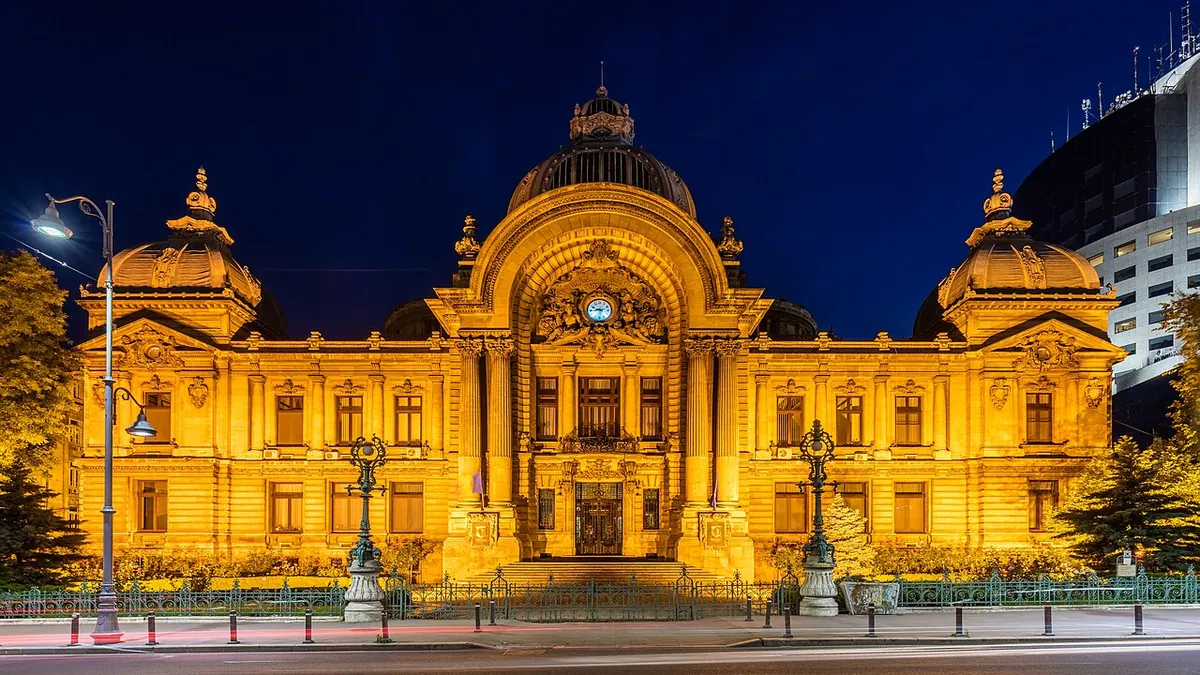
- CEC Palace: A domed 19th-century bank building on Calea Victoriei, best admired from the outside.
- Revolution Square: The square where the 1989 revolution took place, with the Memorial of Rebirth and the former Communist Party building.
- Romanian Athenaeum: The concert hall and symbol of Romanian culture. Visit the interior if there is a concert or a tour slot.
- Cișmigiu Gardens: A pleasant park in the center for a break in the afternoon.
Finish with dinner in the Old Town, where restaurants serve Romanian dishes like sarmale (stuffed cabbage rolls), mămăligă (polenta) and grilled meats.
What should you see on day 2?
On day 2, visit the Palace of the Parliament in the morning, then choose between a green day at Herăstrău Park and the Village Museum or a culture day at the National Museum of Art.
The Palace of the Parliament is one of the largest administrative buildings in the world, built under the Ceaușescu regime. It can only be entered on a guided tour, which usually requires advance booking and a passport or ID, so reserve in advance on the official website and check opening days. The Village Museum in Herăstrău Park is an open-air collection of traditional Romanian houses from across the country. The National Museum of Art of Romania is housed in the former Royal Palace on Calea Victoriei and holds Romanian and European art. Finish the day at the Arcul de Triumf, then head back to the center.
If you want a relaxing alternative, Therme București, a large spa and water park, lies outside the city center and takes a half-day, including the transfer.
How can you adapt the plan for 1, 3, 4 or more days?
To do Bucharest in 1 day, keep the Old Town and Calea Victoriei; for 3 days, add Jewish heritage sites, Cotroceni and a day trip; for 4 or more days, add Sinaia or Brașov.
- 1 day: Lipscani, Stavropoleos, CEC Palace, Revolution Square, Athenaeum. Skip the Palace of the Parliament unless you booked in advance.
- 3 days: Add a day for Jewish heritage, including the Choral Temple and the Museum of the History of the Jews in Romania, the Cotroceni neighborhood and Mogoșoaia Palace, a historic palace on the northwest edge of the city.
- 4 days: Add a day trip by train to Sinaia, about 2 hours away, to visit Peleș Castle, or to Brașov. Check train timetables on the Romanian railway website.
- 5 to 7 days: Combine Bucharest with Transylvania: Brașov, Sighișoara and Sibiu, using trains or a rental car. Do not try to fit all of it into a short trip.
Where should you stay in Bucharest for a short trip?
For a short stay, stay in or near the Old Town, University Square (Universitate) or along Calea Victoriei, because sights, restaurants and metro stations are within walking distance.

A central base lets you return to your hotel between sights and walk home in the evening. Other good areas are Dorobanți and Floreasca, which are quieter, with parks and cafes, but farther from the historic center. The airport is connected to the center by train and bus, and ride-hailing apps are cheap.
When is the best time to visit Bucharest?
The best time to visit Bucharest is spring (April to June) or early autumn (September to October), when the weather is pleasant for walking.
July and August can be very hot, so plan museums and cafes for the afternoon. Winter is cold and may be snowy, but the city is quieter, and a Christmas market usually appears in the center. Bucharest is zero to one hour behind Israel, depending on the season, so there is little jet lag.
What mistakes should you avoid in Bucharest?
The biggest mistake is trying to see everything on foot in two days, which leaves you tired by the afternoon of day 2 and rushing through the Palace of the Parliament.
- Underestimating distances: The Palace of the Parliament is about 2 km from the Old Town, and Herăstrău Park is on the opposite side of the city. Use the metro or a ride-hailing app.
- Skipping reservations: The Palace tour and concerts at the Athenaeum can sell out, so book ahead.
- Leaving museums for last: Many close earlier than you expect and often on Mondays, so check opening days before you go.
- Ignoring the weather: Mix indoor and outdoor stops so that a rain shower or heat wave does not ruin the day.
Practical tips for travelers from Israel
Romania is part of the EU and the Schengen area, but check the current entry rules for Israeli passport holders on official sources and the Israeli Foreign Ministry pages before you book.
- Check current flight schedules from Tel Aviv; do not assume a specific direct route.
- Walk the center, use the metro for longer distances and ride-hailing apps in the evening.
- Cards are widely accepted, but carry some Romanian lei for small purchases and kiosks.
- Book the Palace of the Parliament tour in advance, and bring your passport.
- Do not overpack the schedule; the biggest mistake is rushing through the center and skipping meal breaks.
If you keep kosher or observe Shabbat, check with the local Jewish community or a Chabad house before you travel, and plan meals in advance.
FAQ
Is 2 days enough for Bucharest?
Yes. Two days covers the Old Town, Calea Victoriei, Revolution Square, the Romanian Athenaeum, the Palace of the Parliament and one park or museum. You will move briskly, but it is a good length for a first visit or a weekend break.
Do you need to book the Palace of the Parliament?
Yes, plan to. Visits are by guided tour only, and you usually need to reserve in advance and bring a passport or ID. Check the official website for opening days and tour times before you fix your itinerary.
What is the best area to stay in Bucharest?
For a short trip, choose the Old Town, University Square or Calea Victoriei. These areas put sights, restaurants and metro stations within walking distance, so you save time and can easily return to your hotel between stops.
What can you add with a third day in Bucharest?
Add Jewish heritage sites such as the Choral Temple and the Museum of the History of the Jews in Romania, the Cotroceni neighborhood and Mogoșoaia Palace. Alternatively, take a train day trip to Sinaia to see Peleș Castle.
Is Bucharest walkable?
The historic center is walkable, especially the Old Town and Calea Victoriei. For farther points like Herăstrău Park, the Village Museum and the Arcul de Triumf, use the metro or a ride-hailing app, which are inexpensive.
When is the best time to visit Bucharest?
Spring and early autumn have mild weather for walking. Summer can be very hot, and winter is cold but quieter, with a Christmas market in the center. Bucharest is zero to one hour behind Israel, so jet lag is minimal.